



Why Strategic Placement of Acoustic Panels Works Better Than Full Coverage
Table of Contents
- Introduction – Rethinking Acoustic Panel Coverage
- How Sound Behaves Inside Enclosed Spaces
- Key Areas Where Acoustic Panels Make the Biggest Difference
- NRC Values and Why Placement Matters More Than Quantity
- How Many Acoustic Panels Do You Actually Need?
- Absorption vs. Diffusion: A Balanced Acoustic Panel Strategy
- Why Professional Projects Avoid Full Acoustic Panel Coverage
- Conclusion – Smarter Acoustic Panel Solutions for Modern Spaces
1. Introduction – Rethinking Acoustic Panel Coverage
In offices, studios, conference rooms, and commercial interiors, poor acoustics are one of the most common yet overlooked problems. Echo, excessive reverberation, and unclear speech can quickly reduce productivity, comfort, and overall sound quality. A common misconception is that better acoustics require covering every wall with Acoustic Panels.
In reality, professional acoustic design follows a different rule: strategic placement of acoustic panels delivers better results than full surface coverage. This approach is not only more effective from a sound-control perspective, but also more economical and visually balanced—especially for large projects and commercial spaces.
2. How Sound Behaves Inside Enclosed Spaces
Sound does not spread evenly throughout a room. When sound waves are produced—by voices, speakers, or machinery—they travel in predictable paths, reflecting off hard surfaces such as walls, ceilings, glass, and floors. Certain reflection points contribute disproportionately to acoustic problems.
These early reflections reach the listener’s ears shortly after the direct sound, causing:
- Echo and flutter echo
- Reduced speech intelligibility
- Listener fatigue in offices and meeting rooms
Acoustic panels are most effective when installed at these critical reflection points rather than distributed randomly across all surfaces.
3. Key Areas Where Acoustic Panels Make the Biggest Difference
Professional projects focus acoustic panel installation on a few high-impact zones:
3.1 First Reflection Points
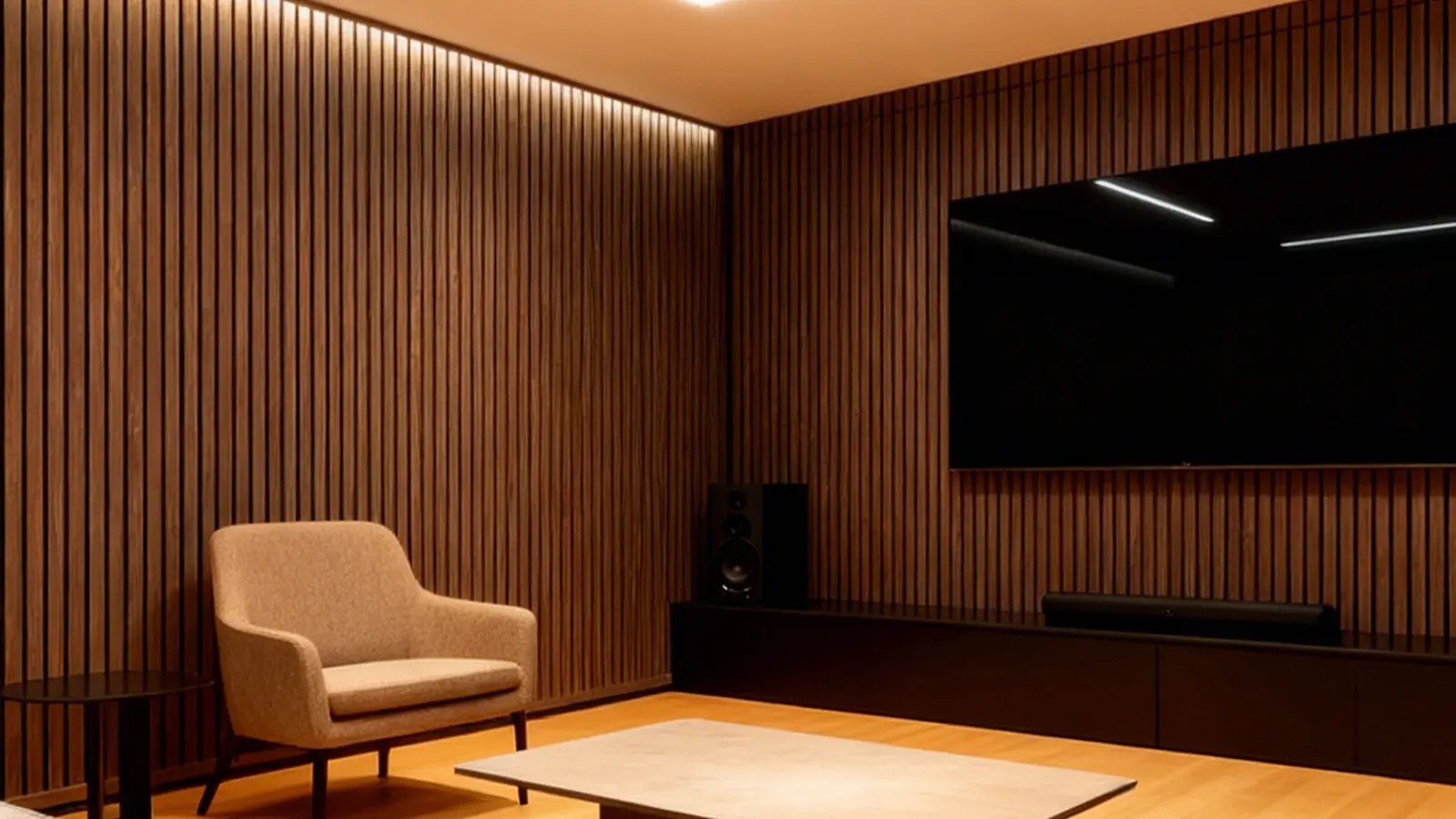
These are the wall and ceiling areas where sound reflects directly toward listeners. Treating these zones with wall-mounted or ceiling-mounted acoustic panels can significantly improve clarity with minimal material usage.
3.2 Corners and Low-Frequency Pressure Zones
Low-frequency sound tends to build up in corners. Installing thicker acoustic panels or bass traps in these areas helps control boominess and resonance far more effectively than thin panels spread across flat walls.
3.3 Rear Walls in Medium to Large Rooms
In conference rooms, studios, and open offices, untreated rear walls often cause late reflections that blur speech and music. Targeted acoustic panels or hybrid solutions in these areas provide noticeable improvement without over-absorbing the space.
In most projects, treating these areas accounts for only 15–25% of total surface area, yet resolves the majority of acoustic issues.
4. NRC Values and Why Placement Matters More Than Quantity
The performance of acoustic panels is commonly measured using the Noise Reduction Coefficient (NRC). High-quality acoustic panels typically achieve NRC values between 0.8 and 1.0, meaning they absorb a significant portion of sound energy.
However, NRC performance depends on more than just the panel itself:
- Panel thickness
- Installation method
- Distance from the wall (air gap)
- Location relative to sound reflections
For example, a properly placed 40mm or 50mm acoustic panel with an air gap can outperform multiple thinner panels installed flush across a larger area. This is why professional designs prioritize placement strategy over sheer panel quantity.
5. How Many Acoustic Panels Do You Actually Need?
In a typical commercial room—such as a 30–40 m² meeting space—untreated reverberation times often exceed comfortable levels. Strategic installation of acoustic panels covering approximately 20% of available surfaces can reduce reverberation by more than half.
Adding more panels beyond this point produces diminishing returns and may even result in an acoustically “dead” environment, which is undesirable for most offices, classrooms, and public spaces.
This is why experienced contractors and designers avoid full coverage solutions unless the space serves a very specific purpose, such as anechoic testing rooms.
6. Absorption vs. Diffusion: A Balanced Acoustic Panel Strategy
Not all acoustic solutions are designed to absorb sound. In many projects, diffusion plays an equally important role. Diffusive surfaces scatter sound energy rather than eliminating it, helping maintain a natural acoustic feel.
An effective acoustic panel strategy often includes:
- Absorptive acoustic panels at first reflection points
- Thicker panels or bass traps in corners
- Diffusive or hybrid panels on rear walls
This balanced approach improves sound control while preserving comfort and spatial character.
7. Why Professional Projects Avoid Full Acoustic Panel Coverage
From a project and procurement perspective, full wall coverage rarely makes sense. Contractors, designers, and distributors prioritize:
- Cost efficiency – Less material, better performance
- Design flexibility – Panels integrated into modern interiors
- Performance control – Avoiding over-absorption
- Sustainability – Reduced material waste
As a result, most commercial and institutional projects rely on carefully planned acoustic panel layouts rather than excessive installation.
8. Conclusion – Smarter Acoustic Panel Solutions for Modern Spaces
Effective acoustic treatment is not about how many acoustic panels you install, but where and how you install them. Strategic placement delivers clearer sound, improved comfort, and better overall performance—without unnecessary cost or visual compromise.
For offices, studios, schools, and large commercial projects, a well-designed acoustic panel solution provides maximum impact with minimal coverage. This is why experienced buyers and professionals focus on precision, not excess, when selecting and installing acoustic panels.