







Why Global Buyers Increasingly Choose China as Their Acoustic Panel Manufacturing Base
Table of Contents
- Introduction: The Global Rise of Acoustic Solutions
- Acoustic Panels as a Standard, Not an Upgrade
- Why Manufacturing Origin Matters More Than Ever
- Cost Efficiency Without Sacrificing Performance
- Depth of Product Ecosystems in China
- Custom Manufacturing for Commercial Projects
- Engineering Support Beyond the Product
- Export Infrastructure Built for Scale
- Quality Control and International Certification
- Risk Management Through Supply Chain Maturity
- Comparing China with Other Manufacturing Regions
- Long-Term Value Over Short-Term Pricing
- Conclusion: China’s Strategic Role in Acoustic Panel Supply
1. Introduction: The Global Rise of Acoustic Solutions
In modern architecture and interior design, acoustics has quietly become a defining performance factor. Whether in open-plan offices, hospitality environments, educational facilities, or residential developments, controlling sound is now essential rather than optional.
As this demand grows globally, buyers are paying closer attention not only to acoustic performance but also to supply reliability, cost structure, customization capability, and technical support. In this context, China has emerged as a dominant manufacturing hub for acoustic panels, supplying markets across Asia, the Middle East, Europe, Oceania, Africa, and the Americas.
This shift is not driven by price alone. It reflects deeper structural advantages within China’s manufacturing ecosystem.
2. Acoustic Panels as a Standard, Not an Upgrade
A decade ago, acoustic panels were often treated as specialty items—used mainly in studios, theaters, or premium spaces. Today, they are standard components in:
- Corporate offices and shared workspaces
- Hotels, restaurants, and lounges
- Schools, libraries, and training centers
- Healthcare facilities and clinics
- High-density residential buildings
This broader adoption has transformed acoustic panels from niche products into high-volume Building Materials, demanding industrial-scale production and consistent quality—areas where China excels.
3. Why Manufacturing Origin Matters More Than Ever
In the past, buyers focused primarily on product appearance and basic performance. Today’s procurement decisions are influenced by:
- Supply chain stability
- Batch-to-batch consistency
- Ability to support phased projects
- Speed of technical communication
- Compliance with international standards
Manufacturing origin directly impacts all of these factors. China’s advantage lies in its ability to integrate raw materials, processing, finishing, testing, and export logistics within a single, mature ecosystem.
4. Cost Efficiency Without Sacrificing Performance
China’s cost competitiveness is not simply the result of low labor costs. It is driven by:
- Vertical integration of raw materials (PET fiber, MDF, felt, laminates)
- Automated production lines that reduce waste
- High-volume purchasing power
- Optimized factory layouts designed for export production
As a result, Chinese acoustic panels typically offer a stronger price-to-performance ratio than products manufactured in regions with fragmented supply chains.
For large commercial or multi-phase projects, this pricing stability becomes a critical advantage.
5. Depth of Product Ecosystems in China
One of the most overlooked strengths of Chinese acoustic panel manufacturers is the breadth of available solutions under one roof.
Common product categories include:
- PET polyester acoustic panels
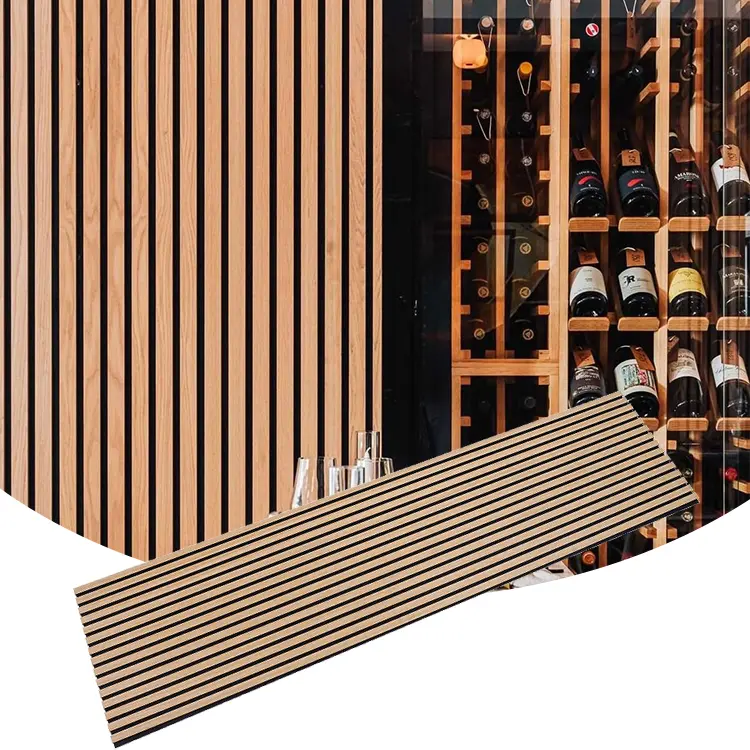
- Wood slat panels with acoustic backing
- Fabric-wrapped fiberglass panels
- Perforated MDF acoustic boards
- Grooved wooden panels
- Ceiling baffles and suspended acoustic systems
Instead of sourcing from multiple suppliers, buyers can consolidate procurement with a single Chinese manufacturer—reducing coordination costs and technical risk.
6. Custom Manufacturing for Commercial Projects
Global projects rarely fit standard dimensions or designs. Chinese factories are structured to handle:
- Non-standard panel sizes
- Custom colors and surface finishes
- Project-specific perforation patterns
- Branding and private labeling
- Acoustic performance tuning based on NRC targets
This level of customization is difficult to achieve in markets where manufacturers focus primarily on standardized retail products.
7. Engineering Support Beyond the Product
Experienced Chinese acoustic panel suppliers increasingly position themselves as solution providers, offering:
- Acoustic performance data and test reports
- Installation drawings and system details
- CAD and BIM-compatible files
- Pre-project sampling and mock-ups
This technical support allows architects, designers, and contractors to integrate acoustic panels earlier in the design phase—reducing revisions and installation issues later.
8. Export Infrastructure Built for Scale
China’s export infrastructure is designed for high-volume building materials. Key advantages include:
- Multiple major seaports with frequent global sailings
- Standardized export packaging systems
- Familiarity with international trade documentation
- Strong relationships with global freight forwarders
This infrastructure ensures predictable lead times, even for full-container or repeat shipments.
9. Quality Control and International Certification
Leading Chinese manufacturers invest heavily in quality systems, including:
- Raw material inspection protocols
- In-process quality monitoring
- Final batch testing
- Third-party acoustic and fire testing
Many products comply with international standards for sound absorption, fire resistance, and environmental performance—making them suitable for globally standardized projects.
10. Risk Management Through Supply Chain Maturity
Supply chain disruptions have highlighted the importance of manufacturing resilience. China’s acoustic panel industry benefits from:
- Multiple alternative material suppliers
- Scalable production capacity
- Backup logistics routes
This reduces the risk of delays and ensures continuity for long-term buyers.
11. Comparing China with Other Manufacturing Regions
While Europe and Japan offer premium branding and design heritage, they often come with higher costs and limited flexibility. Emerging manufacturing regions may offer lower prices but lack consistency and technical depth.
China occupies a middle ground—combining industrial efficiency with customization and technical competence.
12. Long-Term Value Over Short-Term Pricing
For experienced buyers, sourcing decisions are increasingly based on total project value, not unit price alone. This includes:
- Fewer defects
- Stable reordering
- Consistent specifications
- Reliable delivery
Chinese manufacturers are structured to support these long-term requirements.
13. Conclusion: China’s Strategic Role in Acoustic Panel Supply
China’s position as a global acoustic panel manufacturing base is the result of decades of industrial development, export experience, and continuous technical improvement.
For buyers seeking reliable performance, scalable supply, and long-term partnership potential, China remains one of the most strategically sound sourcing options in the global acoustic panel market.