




Understanding Acoustic Panel Performance: NRC, Absorption, and Real-World Results
Table of Contents
- Introduction: Beyond Product Descriptions
- What Is NRC and Why It Matters
- Frequency Range and Human Perception
- Installation Impact on Performance
- Real-World Expectations vs Laboratory Results
- Conclusion
1. Introduction: Beyond Product Descriptions
In an increasingly noisy world, acoustic panels have become indispensable tools for improving sound quality in a wide range of spaces—from bustling open-plan offices and crowded classrooms to intimate home theaters and professional recording studios. Yet, for many buyers, designers, and facility managers, navigating the technical landscape of acoustic panel performance can feel overwhelming. Marketing materials often highlight buzzwords and technical metrics without clearly explaining how these translate to tangible improvements in real-life environments. The consequence? Misaligned expectations, poor purchasing decisions, and spaces that fail to deliver the desired sound comfort.
2. What Is NRC and Why It Matters
At the core of acoustic panel performance lies the Noise Reduction Coefficient (NRC)—a standardized metric that quantifies how well a material absorbs sound energy rather than reflecting it. NRC is calculated as the average of a material’s sound absorption coefficients at four key frequencies: 250Hz, 500Hz, 1000Hz, and 2000Hz. These frequencies are not arbitrary; they cover the mid-to-high range that is most relevant to human speech, office equipment noise, and daily ambient sounds—precisely the sounds that most often disrupt comfort and communication.
3. Frequency Range and Human Perception
Sound is measured in hertz (Hz), with the human ear capable of detecting frequencies from approximately 20Hz (deep bass) to 20,000Hz (high-pitched treble). Not all frequencies affect human comfort and perception equally, and Acoustic Panels are engineered to target the ranges that matter most in everyday settings. To fully appreciate how panels perform, it’s essential to break down sound into three key frequency bands and their impact on human experience:
- High frequencies (2000Hz–20,000Hz): High-pitched sounds like bird chirps, keyboard clicks, and glass clinking fall into this range. These frequencies are short-wavelength and easier to absorb with standard acoustic panels, as their energy is quickly dissipated by the panel’s porous structure. Excessive high-frequency noise can feel shrill and fatiguing, but most panels address this range effectively without specialized design.
The key takeaway is that an NRC rating, while useful, averages absorption across mid-to-high frequencies—meaning two panels with the same NRC might perform differently at specific frequencies. For example, a panel with an NRC of 0.8 might absorb 90% of high frequencies but only 70% of mid frequencies, while another 0.8 NRC panel could have a more balanced absorption curve. This is why, for spaces where speech clarity is paramount (e.g., classrooms, call centers), it’s worth looking beyond NRC to the panel’s absorption coefficients at individual frequencies—especially 500Hz and 1000Hz, which are central to speech.
4. Installation Impact on Performance
Even the highest-quality acoustic panels—with impressive NRC ratings and optimized frequency response—will fail to deliver expected results if installed incorrectly. Acoustic performance is not solely a property of the panel itself; it is a function of how the panel interacts with its environment. Poor installation can negate the panel’s absorption capabilities, leading to wasted investment and persistent acoustic issues. Below are the critical installation factors that directly impact performance, along with best practices to ensure success:
4.1 Panel Spacing
The distance between individual panels (and between panels and room boundaries) plays a key role in reducing sound reflections. When panels are placed too close together, they create "acoustic dead zones" where sound waves reflect off adjacent panels or surfaces, undermining absorption. Conversely, spacing panels too far apart leaves large areas of reflective surface unaddressed, limiting overall noise reduction. For most spaces, a spacing of 1 to 3 feet between panels is recommended, with coverage of 20–30% of the total wall or ceiling area (depending on the acoustic challenge). In high-noise environments like open offices, increasing coverage to 40–50% may be necessary.
4.2 Air Gap Behind Panels
One of the most overlooked installation details is the air gap between the back of the panel and the mounting surface (e.g., a wall or ceiling). This gap acts as an extension of the panel’s absorption structure, significantly enhancing its ability to absorb low-to-mid frequencies. Without an air gap—i.e., when the panel is mounted flush against the wall—the panel’s effectiveness at lower frequencies drops dramatically, as the sound waves cannot penetrate deep enough into the panel’s porous core. Best practices vary by panel thickness: for 2-inch thick panels, a 1–3 inch air gap is ideal; for 4-inch panels, a 2–5 inch gap yields optimal results. Some manufacturers provide specific air gap recommendations, so consulting the product manual is essential.
5. Real-World Expectations vs Laboratory Results
Laboratory-tested NRC values and absorption coefficients provide a valuable starting point for evaluating acoustic panels, but they must be interpreted with caution—real-world performance rarely matches laboratory results exactly. This discrepancy stems from the fundamental difference between controlled laboratory conditions and the complexity of real spaces. Understanding this gap is essential to setting realistic expectations and designing effective acoustic solutions.
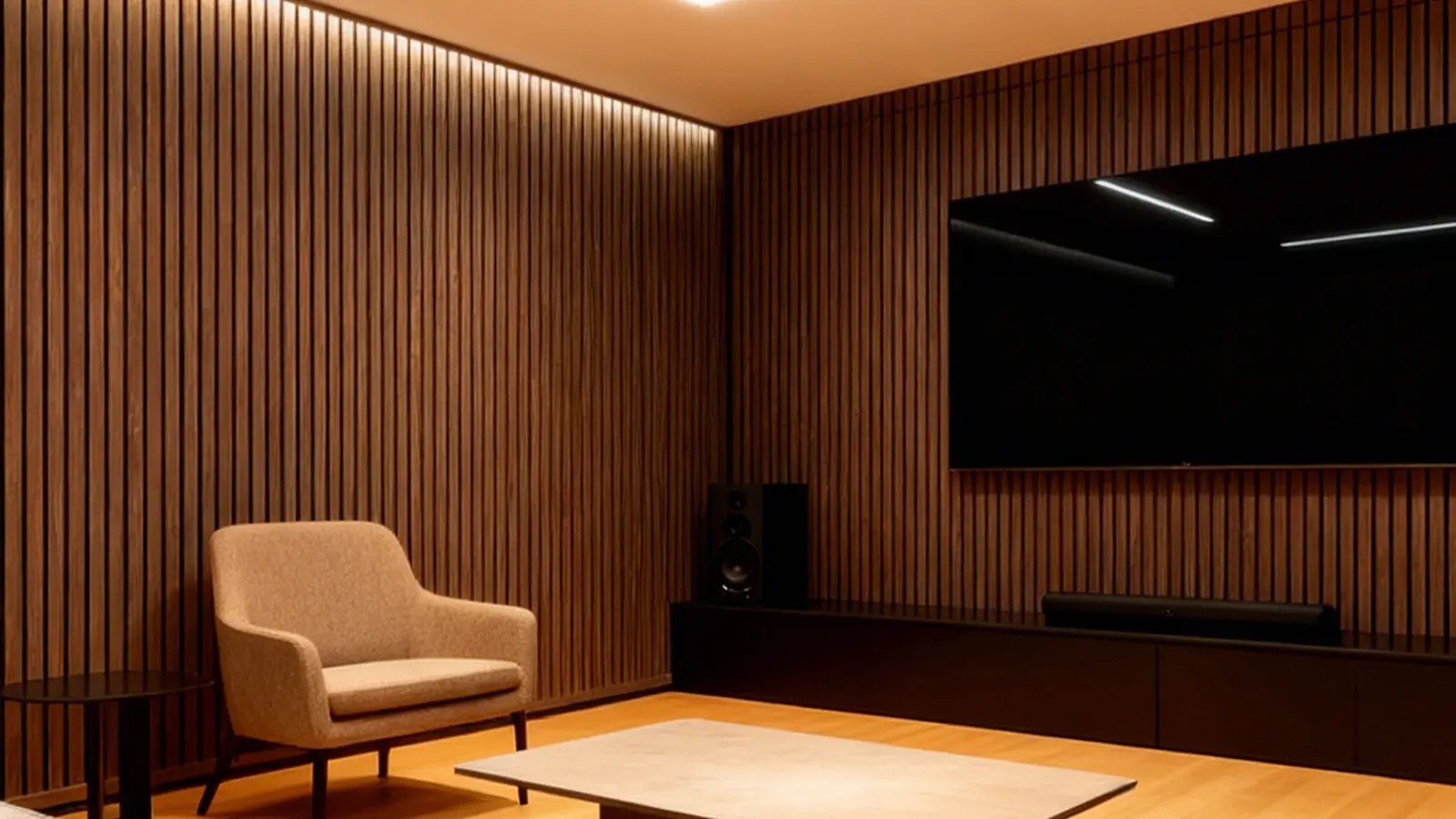
Another key consideration is room size and usage. In a large open office with dozens of employees, a few well-placed panels will not eliminate all noise—but they can reduce echo and improve speech intelligibility, making conversations and phone calls easier. In a small home theater, however, full-Wall Panel coverage (paired with bass traps in corners) can create a near-professional acoustic environment, as the space is smaller and has fewer competing sound sources. Setting realistic expectations means recognizing that acoustic panels are not a "magic fix"—they are a tool to mitigate specific issues, and their effectiveness depends on aligning the solution with the space’s unique needs.
In the end, the goal of acoustic panels is to enhance how we experience sound—whether that means making a conversation clearer, a recording cleaner, or a workspace more peaceful. When selected and installed with care, acoustic panels deliver reliable improvements that extend beyond technical specifications to create spaces that feel intuitive, balanced, and welcoming. By approaching acoustic design with knowledge and intention, you can turn even the noisiest spaces into havens of sound comfort.