
The Manufacturing Revolution – How UV Curing Technology Transformed Decorative Surfaces in 2025
Table of Contents
- Introduction and Core Technology
- Production Process and Polymerization
- Manufacturing Efficiency Advantages
- Dimensional Stability Characteristics
- Environmental Sustainability
- Installation Methodology Innovation
- Texture Authenticity and Market Recognition
- Technological Evolution and Future Trends
- Recyclability and Circular Economy
- Aesthetic Democratization and Cost Advantages
- Market Outlook and Industry Transformation
1. Introduction and Core Technology
When Shanghai-based manufacturer Linhua Decor Materials shipped its first container of UV marble sheets to a Dubai hotel developer last March, production manager Wei Chen noticed something unusual. The panels survived 42°C desert heat during unloading without surface distortion—a test natural marble often fails due to thermal expansion stresses. This resilience stems from a manufacturing breakthrough quietly reshaping interior architecture worldwide: ultraviolet light curing technology applied to composite substrates.
2. Production Process and Polymerization
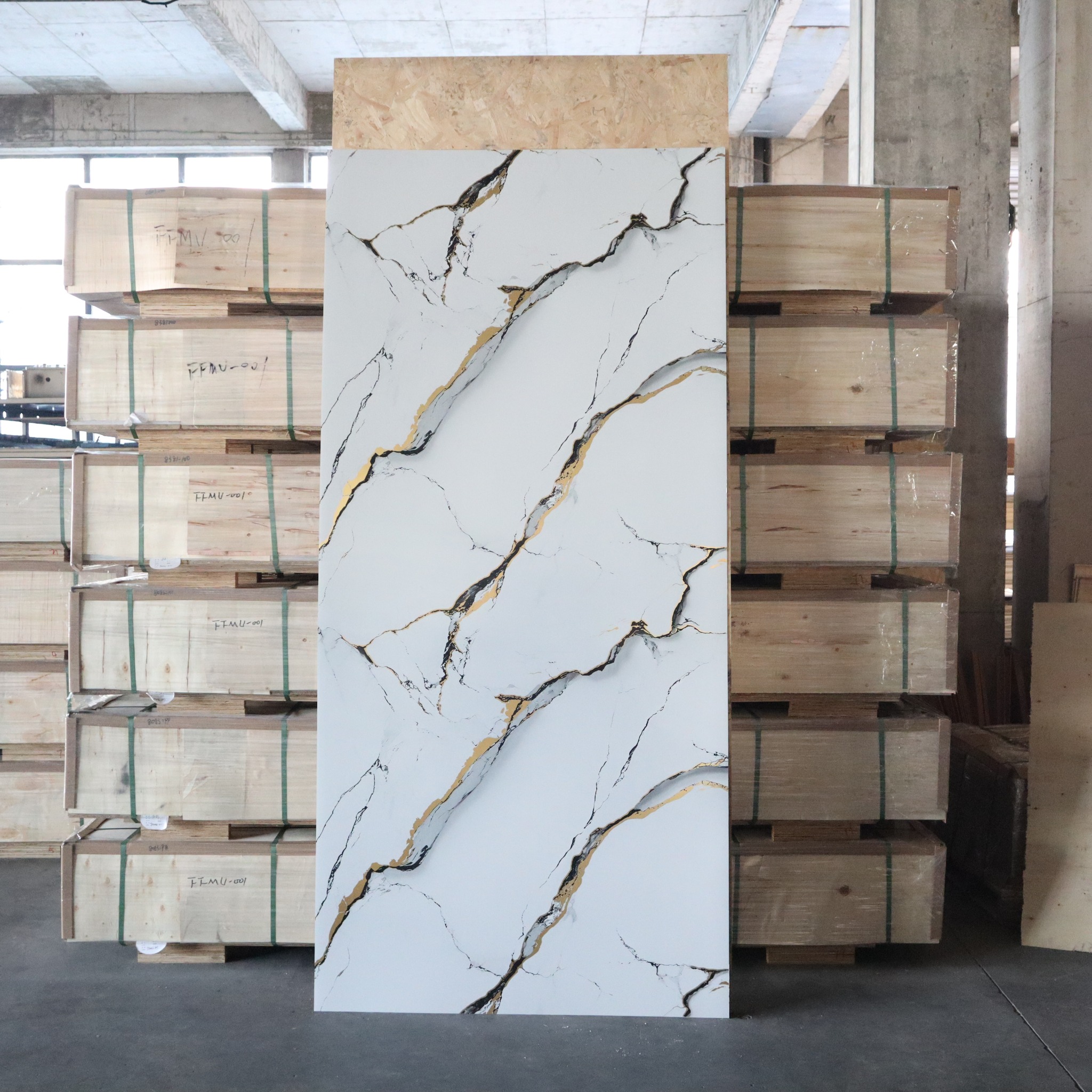
Unlike traditional decorative panels relying on solvent-based coatings requiring 24–48 hours drying time, modern Uv Marble Sheets undergo instantaneous polymerization under specialized mercury-vapor lamps emitting 365nm wavelength radiation. During production at facilities like those in Linyi's industrial zone, PVC-calcium carbonate composite sheets (typically 55% polyvinyl chloride, 40% ground calcium powder, and 5% stabilizers) pass through digital printers replicating Calacatta Gold or Nero Marquina veining patterns with 1200 DPI precision. Immediately afterward, a transparent acrylic oligomer coating—approximately 30–50 microns thick—is applied via precision roller coaters before entering the UV chamber.
What happens in those 8–12 seconds under intense ultraviolet exposure defines the product's performance characteristics. Photoinitiators within the coating absorb UV energy, triggering cross-linking reactions that transform liquid resin into a hardened, glass-like surface with 4H–6H pencil hardness ratings. This molecular restructuring creates a barrier impervious to household chemicals, moisture penetration, and abrasion—critical for high-traffic commercial environments.
3. Manufacturing Efficiency Advantages
The manufacturing efficiency gains prove equally transformative. A single production line operating at 8 meters per minute can output 400–700 kilograms hourly—translating to approximately 1,200 standard 1220×2440mm panels daily. Compare this to natural marble quarrying where a single 20-ton block might yield only 150–180 usable slabs after cutting, polishing, and quality grading. This scalability explains why project managers for Singapore's upcoming Marina Bay Residences selected UV marble sheets for all 387 bathroom walls—a decision saving SGD $218,000 versus natural stone while maintaining visual continuity across units.
4. Dimensional Stability Characteristics
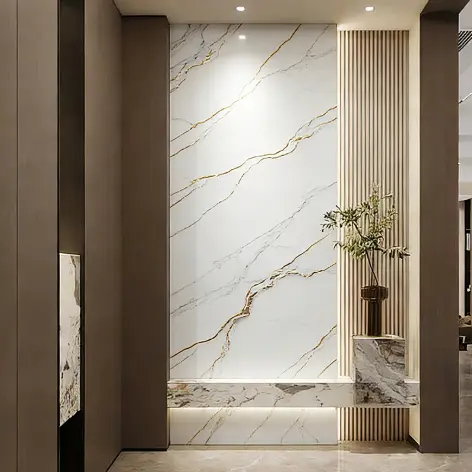
Material scientists emphasize another advantage often overlooked: dimensional stability. Natural marble expands approximately 5–7 micrometers per meter per degree Celsius temperature change. In contrast, UV marble sheets exhibit thermal expansion coefficients below 30×10⁻⁶/°C—comparable to engineered wood products. This stability prevents seam separation in large installations, crucial for seamless feature walls exceeding 10 square meters. Beijing interior designer Mei Lin recently specified these panels for a penthouse television wall spanning 4.2 meters width; the single-panel installation eliminated visible joints that would compromise the dramatic Statuario veining continuity.
5. Environmental Sustainability
Environmental considerations increasingly influence specification decisions. While natural marble extraction consumes significant water for cutting and generates substantial quarry waste, UV marble sheet production incorporates up to 30% post-industrial calcium carbonate recovered from paper manufacturing byproducts. Furthermore, the UV curing process emits near-zero volatile organic compounds compared to thermal drying ovens burning natural gas.
6. Installation Methodology Innovation
Installation methodology represents another paradigm shift. Traditional marble requires skilled stonemasons, structural reinforcement for heavy slabs (natural marble weighs 26–28 kg/m² versus UV sheets at 8–12 kg/m²), and specialized adhesives. UV marble sheets install using standard polymer-modified thinset mortars or even mechanical fastening systems for retrofit applications. Renovation contractor James O'Donnell in Dublin completed a hotel corridor refurbishment in 72 hours using these panels—versus the projected 10-day timeline with natural stone—because his team avoided structural assessments and crane rentals.
7. Texture Authenticity and Market Recognition
Critics occasionally question authenticity, yet advances in texture replication challenge perceptions. New embossing rollers create micro-topography mimicking natural stone's crystalline structure, while multi-layer printing techniques simulate depth through strategic shadow placement. During a blind test at Milan Design Week 2024, 68% of architects couldn't distinguish UV marble sheets from 2cm-thick natural slabs when viewing installed walls under typical residential lighting conditions.
8. Technological Evolution and Future Trends
The technology continues evolving rapidly. Research teams have demonstrated hybrid UV-LED curing systems reducing energy consumption by 35% while enabling curved panel production—opening possibilities for column wraps and arched architectural features previously requiring expensive custom stone fabrication. Meanwhile, nanotechnology additives promise self-cleaning surfaces through photocatalytic reactions breaking down organic contaminants under ambient light.
9. Recyclability and Circular Economy
As global construction embraces circular economy principles, recyclability becomes decisive. End-of-life UV marble sheets can be granulated and reintroduced into new production batches at up to 15% replacement ratios without compromising structural integrity—a closed-loop advantage natural stone cannot match. With commercial real estate developers facing mounting pressure to reduce embodied carbon, these composite solutions offer compelling lifecycle assessments.
10. Aesthetic Democratization and Cost Advantages
The manufacturing revolution extends beyond technical specifications—it democratizes luxury aesthetics. Where natural marble remained exclusive to high-budget projects, UV-cured alternatives deliver comparable visual impact at 40–60% lower installed costs. This accessibility fuels creative experimentation: boutique hotels in Lisbon now feature entire lobbies clad in dramatic book-matched Emperador Dark patterns previously reserved for penthouse lobbies, while residential designers specify full-height bathroom installations without budget anxiety.
11. Market Outlook and Industry Transformation
Industry analysts project the global UV decorative panel market to reach USD $4.3 billion by 2028, growing at 9.7% CAGR—outpacing natural stone's 2.1% growth. This expansion reflects more than cost advantages; it signals a fundamental shift toward performance-driven material selection where beauty and durability coexist without compromise. As architects increasingly specify materials based on holistic performance metrics rather than tradition alone, UV marble sheets exemplify how manufacturing innovation can elevate everyday spaces while respecting environmental constraints—a transformation unfolding panel by panel across continents.