What Is the Best China 3D UV Marble Sheet Supplier?
Choosing the best China 3d Uv Marble Sheet supplier requires more than comparing glossy samples or low prices. The real question is whether a supplier can deliver stable quality, accurate specifications, and dependable support.
Industry reports provide useful market context. Grand View Research has identified continued growth in decorative wall covering and interior surface materials. Fortune Business Insights also reports rising demand for cost-effective, visually attractive construction finishes. However, these reports often group UV marble panels with broader decorative surface categories. They may not measure every 3d Uv Marble Sheet manufacturer separately. That limitation matters.
A professional evaluation should examine the panel’s core materials, surface thickness, embossing depth, UV coating, and fire-performance documentation. Ask for batch test results, not only showroom photographs. A realistic sample should show clean marble veining, a smooth edge, and consistent color under direct light. The backing should remain flat after transport and installation. Small defects can become visible across a large feature wall.
Supplier experience matters too. Review export history, production equipment, quality-control procedures, and response times. Request references from projects using similar humidity, temperature, and installation conditions. Certifications should be verified against the issuing organization. Unverified badges prove very little.
The answer is not obvious. A factory with the lowest quotation may create higher replacement costs later. A premium supplier may still fail if communication is weak. This guide compares China’s leading suppliers through product performance, customization, documentation, delivery reliability, and after-sales service. The goal is practical judgment, not a perfect ranking.
What Is a 3D UV Marble Sheet?
What Is the Best China 3D UV Marble Sheet Supplier?
What Is a 3D UV Marble Sheet?
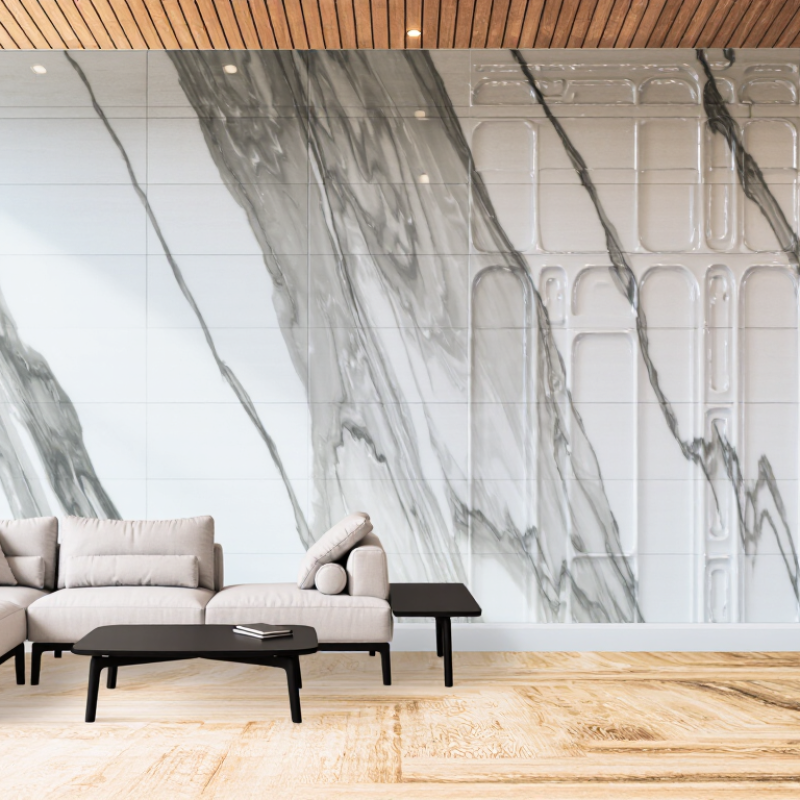
A 3D UV marble sheet is a decorative wall panel designed to imitate natural stone. Its printed surface shows marble veins, while embossed layers create a raised, stone-like texture. The UV coating protects the pattern and adds either a glossy or soft-matte finish. “3D” does not mean the panel is solid marble. It describes the visual depth and surface relief.
Most sheets use PVC, SPC, or other composite materials. They are lighter than stone and easier to cut on site. A standard panel may cover a bathroom wall, reception area, or feature wall with fewer joints. Run your fingers across a sample. Good embossing should feel consistent, not sharp or hollow. Some patterns look convincing in photographs but appear artificial under strong side lighting.
When comparing a China supplier, request physical samples instead of relying on catalog images. Check thickness, backing quality, color consistency, edge straightness, and surface adhesion. Ask for documented test results relevant to your project and destination. A dependable supplier should explain installation limits, cleaning methods, packaging, and batch control clearly. Even well-made panels can vary slightly between production batches. I would not judge quality by shine alone; a beautiful gloss can hide weak embossing or uneven printing. Supplier communication matters more than a polished showroom claim.
What Makes a China Supplier the Best Choice?
What Makes a China Supplier the Best Choice?
A strong China supplier is not simply the cheapest factory. It should convert design files into stable, repeatable surfaces. That matters because UV marble sheets expose flaws under direct lighting. Check gloss uniformity, edge accuracy, color drift, and panel flatness. Request samples from different production batches. One sample proves very little. Grand View Research estimates the global decorative laminates market will grow at about 5% annually through 2030. This growth increases choice, but it also makes supplier comparison more important.
A capable manufacturer should disclose substrate density, coating thickness, abrasion results, formaldehyde testing, and fire performance. Ask which standards support each test. Certificates without batch records are weak evidence. Factory audits should cover calibration, curing temperature, dust control, and packaging. In my experience, corner damage often begins with rushed packing, not manufacturing. Mordor Intelligence identifies residential renovation and commercial interiors as major decorative laminate demand areas. Therefore, consistent color matching matters across large projects. Small differences become obvious beside windows.
Commercial reliability also includes realistic minimum orders, written lead times, spare panels, and responsive engineering support. Confirm how the supplier handles defects before placing a large order. A low quotation may exclude export packing or replacement costs. I have seen attractive samples fail during installation. That is an uncomfortable reminder. The best choice may still require trial orders, independent inspection, and clearer questions than buyers expect.
Which Materials and Manufacturing Standards Matter?
Choosing a China 3D UV marble sheet supplier should begin with materials, not glossy catalogs. In project inspections, I check the core, surface coating, and backing separately. A stable PVC or polymer core should resist moisture and remain flat after cutting. Calcium carbonate fillers can improve stiffness, but excessive loading may make edges brittle. Ask for the exact formulation and thickness tolerance. Do not accept “premium” as a specification. Short samples reveal little.
The decorative layer needs more than attractive veining. UV-cured ink should bond firmly and retain color under light exposure. Request adhesion, abrasion, stain-resistance, and humidity test results. A clear protective coating matters near kitchens, bathrooms, and busy corridors. Check whether the reported results match the actual batch, not an older sample. I once trusted a clean laboratory sheet and ignored uneven backing. That assumption was wrong. Installation later exposed hollow spots and visible ripples.
Manufacturing standards create confidence when evidence supports them. ISO 9001 can indicate controlled processes, but it does not prove every panel is durable. Ask for batch records, incoming-material checks, calibration logs, and pre-shipment inspection photos. Fire performance, VOC emissions, and formaldehyde limits should follow the destination market’s requirements. Use recognized ASTM, EN, or national test methods, with laboratory details and test dates. Confirm dimensions, flatness, color variation, edge strength, and packaging protection in writing. A reliable supplier welcomes independent inspection. Still, factories can miss defects. Build a small approval sample into the contract and test it before full production.
What Is the Best China 3D UV Marble Sheet Supplier?
Material selection and documented testing standards are more reliable supplier indicators than appearance alone. The chart shows commonly reported density ranges for materials used in or associated with UV marble sheet construction.
How to assess a supplier: Request verified material composition, density testing based on ISO 1183-1 or ASTM D792, UV-aging evaluation based on ISO 4892-3 or ASTM G154, and mechanical testing based on ISO 527. A suitable sheet typically combines a rigid PVC or polymer core, mineral filler such as calcium carbonate, and a UV-resistant decorative surface.
Reference values are typical material density ranges in g/cm³; actual sheet density depends on formulation, filler loading, foaming, and production process.
How to Compare Product Quality, Prices, and Customization?
Choosing the best China 3D UV marble sheet supplier requires more than comparing catalog prices. Mordor Intelligence’s 2024 decorative laminates report indicates market growth of nearly 5% annually. That growth attracts capable factories and inconsistent traders. Request samples from the same production batch. Check gloss uniformity, marble depth, edge finishing, and backing adhesion under direct light. A beautiful sample can still fail during installation.
Ask for measurable evidence. Sheets should include thickness tolerance, surface hardness, color difference, and abrasion results. ASTM D2244 supports color-change evaluation, while ASTM D4060 measures abrasion resistance. For interior projects, request UV-aging records aligned with ISO 4892 testing methods. Review batch inspection reports, not only laboratory certificates. Ideally, an independent laboratory verifies key results. Small details matter.
Price comparisons need a fixed specification. Include sheet size, thickness, core material, finish, packaging, minimum order quantity, tooling, and delivery terms. A lower EXW price may hide higher crating or freight costs. For customization, confirm whether the supplier can match a physical color chip, adjust gloss, and produce repeatable textures. Require a signed pre-production sample. My practical mistake was trusting digital renderings; printed color and real light changed the result. Allow a few percent for waste, replacement sheets, and imperfect cutting. A reliable supplier answers technical questions clearly, shares traceable records, and accepts reasonable inspection terms.
What Should Buyers Check Before Placing an Order?
What Is the Best China 3D UV Marble Sheet Supplier?
What Should Buyers Check Before Placing an Order?
Choosing a China 3D UV marble sheet supplier requires more than comparing prices. Check the supplier’s production experience, material specifications, and quality control process. Ask whether the sheets use stable substrates, consistent thickness, and UV-resistant surface coatings. Small details matter. Request recent samples from actual production, not only showroom pieces. Compare the sample’s gloss, marble pattern, edge finishing, and surface texture under natural light.
Buyers should also test adhesion, scratch resistance, color consistency, and moisture performance. Ask for clear test data and production tolerances. A professional supplier should explain how defects are inspected and recorded. Do not guess. Confirm monthly capacity, minimum order quantity, lead time, packaging method, and replacement procedures before placing an order. Photos of cartons are useful, but a packing sample is more reliable.
Communication reveals practical reliability. Check whether technical questions receive precise answers or vague promises. Confirm the exact sheet size, thickness, core material, surface finish, and accepted defect range in writing. Independent pre-shipment inspection can reduce unpleasant surprises. Still, inspection is not perfect. A small sample may not represent every batch. Buyers should keep reserve time for rechecking colors and dimensions after delivery, especially when several production lots are involved. A low quotation can hide weaker coating, fragile edges, or inconsistent printing. Evaluate the complete purchasing risk, not just the invoice price.